More about the expedition
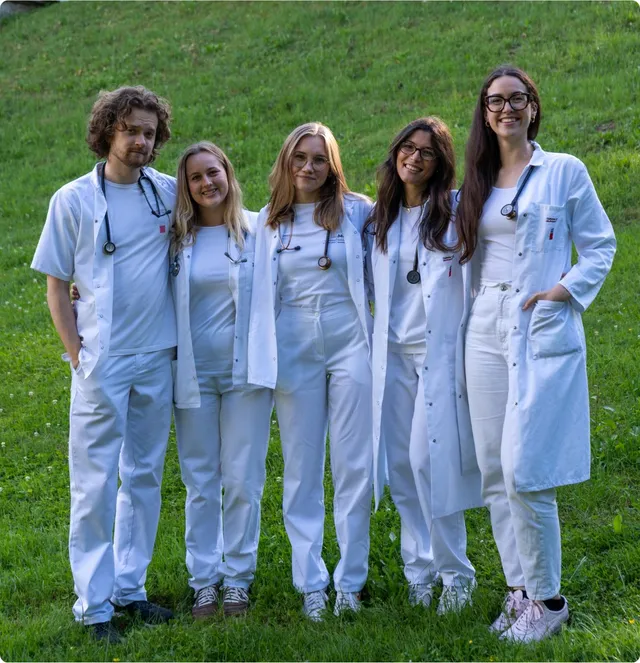
These humanitarian medical expeditions run under the Section for Tropical and Travel Medicine of the Slovenian Medical Association, which has spent decades contributing to better healthcare for people in developing countries.
Our expedition year will be especially significant for the Section, as 2027 marks 50 years since its first medical expedition to the tropics, which set out in 1977. Since then, more than 1,500 medical students, doctors, and nurses have joined these humanitarian expeditions, offering their knowledge and help to people across Africa, South and Central America, Asia, and Oceania.
Today expeditions run regularly in Uganda, Zambia, and Kenya. Each expedition typically lasts three months, with four teams rotating through each location every year. This organization ensures uninterrupted presence and continuous healthcare for the local population throughout the year.
Our work is entirely voluntary. Expedition costs are covered through donations and contributions, and we organize everything ourselves.
The first expedition to Uganda …
… was organized in 2006, and since 2012 volunteers have regularly traveled to Bwama Island on Lake Bunyonyi. The Bwama Health Center operates there, providing the local community with free primary healthcare.
The land for the health center was donated by the Kigezi Diocese (Church of Uganda), and the center itself was built by the charity Edrisa UK. The organization still maintains the outpatient facilities today, financially supports the center, and ensures it runs smoothly. Uganda’s Ministry of Health also contributes, providing nursing staff and some of the required medicines. The Slovenian Section for Tropical and Travel Medicine regularly contributes medicines, medical equipment, and volunteers — medical students and young doctors who take part in outpatient work, run outreach clinics in the surrounding villages, and take part in educational activities. The health center also includes a maternity ward.
Besides healthcare, the center also plays an important role in health education for the local population. Through various prevention programs it promotes good hygiene habits, proper oral hygiene, a healthy diet, and awareness around preventing HIV infection.
Our task is to provide the residents around Lake Bunyonyi with basic healthcare. At the health center we will carry out diagnostics and treatment of illnesses, basic surgical procedures, and care for chronic wounds and injuries. We will encourage residents toward preventive care, educate them on basic health practices, and so help improve the quality of their everyday lives. As part of our care we will also run outreach clinics — trips to remote locations around the lake to provide basic healthcare and education for schools and people who cannot reach Bwama Island.
How well do you know Uganda?
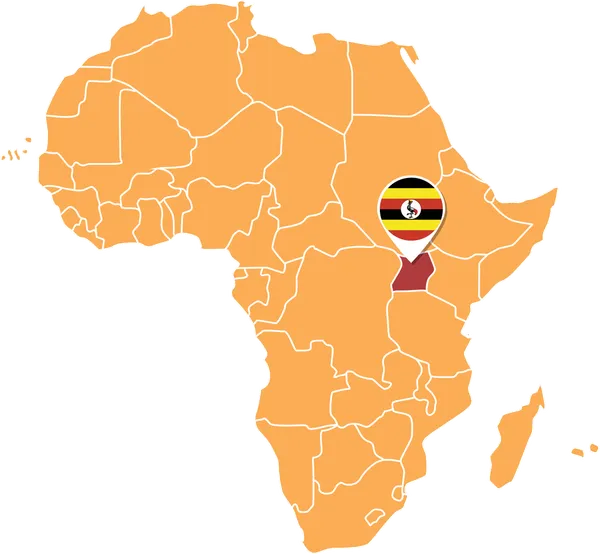
Uganda is a country in East Africa. Its capital is Kampala, which is also the country’s largest city. Uganda borders Kenya, South Sudan, the Democratic Republic of the Congo, Rwanda, and Tanzania. Part of Lake Victoria, one of the largest freshwater lakes in the world, lies in the south of the country.
The name Uganda was given to the region by the British, who established a protectorate of the United Kingdom there at the end of the 19th century. The name is thought to derive from "U" (land, in Swahili) and "Ganda" (the name of the local people), referring to the Ganda people and the Kingdom of Buganda, which played an important role in the region’s history. Uganda gained independence in 1962.
Uganda today has a population of just under 50 million. The official languages are English and Swahili, though residents also speak many local languages.
Most people work in agriculture, growing coffee, tea, bananas, corn, and cotton. Coffee is one of the country’s most important export products.
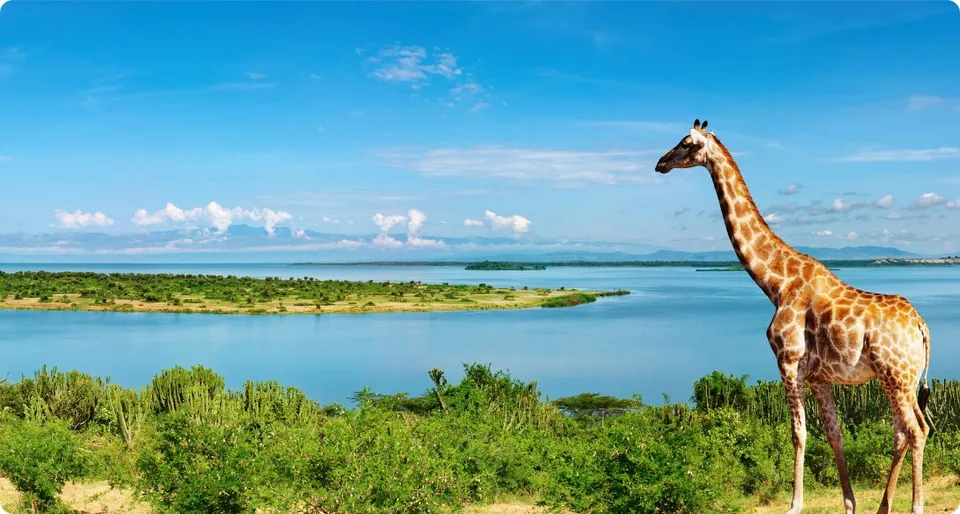
Uganda’s nature is remarkably diverse. The country is known for its tropical forests, savannas, mountains, and lakes. Its national parks — most notably Bwindi Impenetrable National Park, Queen Elizabeth National Park, and Murchison Falls National Park — are home to numerous wild animals such as elephants, lions, giraffes, hippos, crocodiles, and mountain gorillas. The mountain gorillas in particular draw visitors from all over the world.
Today the country continues to develop in education, tourism, and the economy, although it still faces poverty and other development challenges.
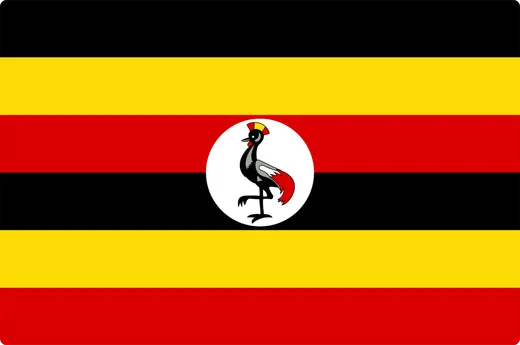
Coat of arms and flag
- Coat of arms
- The grey crowned crane (Balearica regulorum), Uganda’s national bird, a symbol of happiness, longevity, and prosperity.
- Black in the flag
- represents the people of Uganda.
- Yellow in the flag
- represents the sun.
- Red in the flag
- represents brotherhood and the unity of Africans through shared blood.
Lake Bunyonyi
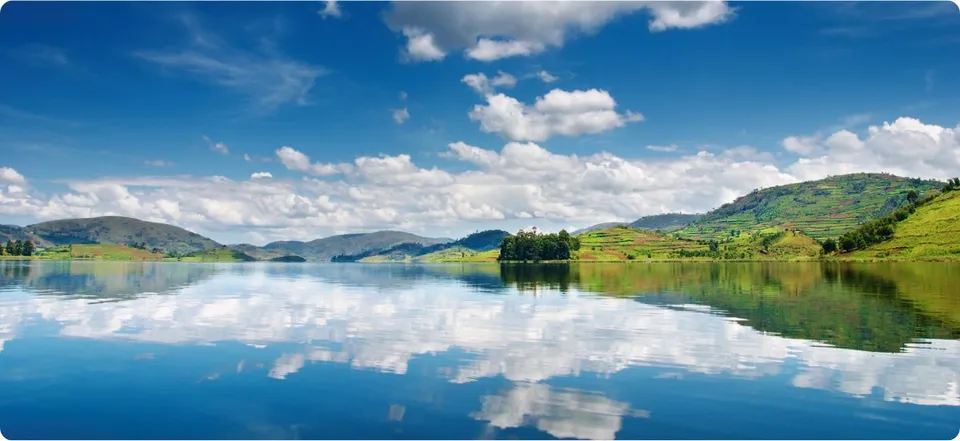
Lake Bunyonyi is one of the best-known and most picturesque lakes in Uganda. It lies in the southwest of the country, close to the border with Rwanda, among the green hills of the Kigezi region. In the local language, "Bunyonyi" means "place of many birds," reflecting the area’s rich birdlife. The wider surrounding area is estimated to be home to somewhere between 200,000 and 300,000 people.
The lake is notable for its many islands — reportedly 29 of them. Thanks to its calm water, green islands, and picturesque surrounding hills, it is considered one of Uganda’s most beautiful natural sites. Since it has no crocodiles or hippos, the lake is safe for many water activities, such as swimming, boating, and kayaking.
Lake Bunyonyi also has an important historical role in healthcare. On Bwama Island, where we too are headed, the Scottish missionary Dr. Leonard Sharp founded a health center for treating leprosy between 1920 and 1930. The center was not only a place of medical treatment — it functioned as a self-contained community where people affected by leprosy found refuge from social stigma and could continue their lives with dignity.
At the height of its activity, the center used roughly 47,000 doses of chaulmoogra oil per year — the traditional leprosy treatment of the time, which was less effective and could also be dangerous (today chaulmoogra oil is mainly used in natural cosmetics for dry and sensitive skin). The community on Bwama Island ceased operating in the 1980s, mainly due to the development of more modern and effective leprosy treatments.